
Health workers drive equity, inclusion and response – we need more of them.
By Dr George Kimathi, Director, Institute of Capacity Development (ICD), Amref Health Africa
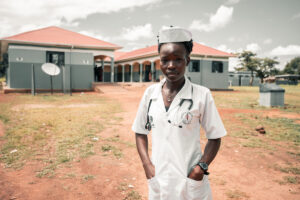
Hellen Hadia works long hours. She is the midwife-in-charge at Mvolo County Hospital, Western Equatoria, South Sudan. Her day rarely ends when she leaves the hospital. On her way home, she will often stop by the home of a family she supports to check in on a breastfeeding baby. Sometimes, she’ll get a call in the middle of the night from a first-time mum who needs advice or reassurance. Never will such a call go unanswered.
Hellen is one of millions of health workers across the African continent on whom whole communities depend. But Africa urgently needs more Hellens. The continent is experiencing a chronic health worker shortage: if current trends continue, Africa will be short of 6.1 million healthcare workers by 2030.
Every missing health worker represents hundreds of people who are going without the services they need. This is both for routine care such as antenatal services and more critically in times of crisis like now in Democratic Republic of Congo (DRC), Uganda, South Sudan or other neighbouring nations where vulnerable communities are at risk from the urgent threat of Ebola. The WHO’s target is 10.9 health workers per 1,000 members of the population. Only one country in southern, eastern and western Africa currently meets this target. Sixteen countries in the WHO AFRO region have less than one health worker for every 1,000 members of the population.
Health workers are everything to the communities they serve
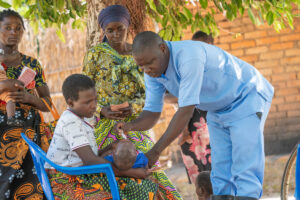
A health worker operating at Primary Health Care level – working out of a dispensary in rural area – will likely see between 70 and 100 patients every day. One of the key roles they play is in preventing sickness by educating communities about risks, helping them take practical steps to protect themselves and their families.
The community response to health emergencies such as Ebola rely on these trained health workers.
Training one health worker at community level has a huge impact because of the number of people they are able to reach – and, crucially, the number of diseases they are able to prevent. Indeed, a well-functioning Primary Health Care system can meet 80% of a community’s needs.
6.1 million missing health workers: How did we get here?
The current health worker crisis is the – perhaps inevitable – result of several factors.
First of all, global inequity has led to historic under-investment in Africa’s health systems and the people who staff them. The GDP of the entire African region (excluding North Africa) is $1.7 trillion. For context, that is about half of the GDP of the United Kingdom. Most governments in the region spend around $7 of every $10 generated to repay their debts to other, wealthier nations, leaving them with just $3 to respond to the current and future needs of their citizens. That debt burden is crippling, and it often leaves African governments unable to do more than the bare minimum – if that. It means they can’t invest, and they can’t look for innovative, creative, sustainable solutions.
Tight budgets force governments to make tough choices. Many training institutions and courses in Africa are chronically under-funded, resulting in health workers who graduate without all the skills they need to provide the highest-quality care in communities. And those communities’ needs are changing. The continent is facing a surge in non-communicable diseases (NCDs) like diabetes, cancer, and hypertension; and despite having done little to contribute to the climate emergency, Africa is grappling with the wide-ranging impacts of the crisis on the health of its people. Chronic under-investment in health worker training means curriculums are not updated, which in turn leads to health systems that are not built to resist, surveil and contain public health emergencies like COVID-19 or, the swiftly escalating rare Bundibugyo strain of Ebola.
Daily frustrations, limited horizons
Budgetary constraints also mean poor working conditions and limited opportunities for advancement, creating a paradoxical mis-match between demand and supply. In many African countries, the number of health workers graduating from medical training colleges is higher than the capacity governments have to absorb them: in other words, national budgets do not stretch to basic, let alone adequate, salaries. Notably, one in three trained health workers in Africa is unemployed or underemployed. This results in qualified health workers looking elsewhere for employment.
In South Sudan, where the impact of under-funded health systems is very clear, I met health workers who have much in common with Hellen. They are operating in facilities which are lacking in basic equipment and even in drugs, which means that all too often, health workers can identify a need but are unable to respond to it. Imagine how frustrating that is: to see a pregnant woman suffering from malaria, and to know how you would handle her case – if only your store cupboards were not bare.
A way forward: Investing in health worker training and well-being
The picture I have painted here is a bleak one – but the good news is that there are concrete steps that can be taken, locally and globally.
African governments urgently need to invest more in health worker training, and in health workers themselves.
At Amref Health Africa, we are calling for increased investment in:
- Pre-service training: resourcing training institutions, infrastructure, faculty, and equipment;
- In-service training, enabling a person who is already working to improve their skills so they can offer more and better services;
- Protecting and caring for health workers, including providing them with protective gear, conducive working environments and social welfare, and listening to health worker voices.
- Leadership and governance: Timely and accurate health workforce data for decision-making; digitalized health worker management information systems, building transformative, gender conscious health leaders and managers.
In terms of training, key priorities include:
- Non-communicable diseases (NCDs), which are a growing threat across the continent;
- Communicable diseases (CDs): new science is being developed all the time, but governments are not updating training and guidelines to keep pace;
- The skills to prepare, manage, prevent, and treat outbreaks like mpox, COVID-19, and Ebola – which of course is an investment not just for people in Africa but worldwide;
- Surveillance enabling us to stop epidemics in their tracks;
- Digital literacy skills;
- The intersection between climate change and health.
A shared challenge calls for global solidarity
Although the health worker shortage is being acutely felt in Africa, this challenge is a shared one. And the global community must come together to meet it.
Increasingly, the health challenges the world is facing are interconnected: the COVID-19 pandemic and the new emerging Ebola crisis make it clear how much we rely on each other to stay safe. The more we can work together to put well-trained, well-supported health workers at the heart of the world’s health systems, the better it is for everyone.