
A fairer model of international health worker recruitment
Margaret Caffrey, Technical Director, Health Systems Strengthening, Global Health Partnerships

International health workers are the backbone of the NHS, providing essential care to patients every day, right across the UK.
The knowledge, skills, and experience of internationally trained doctors, nurses and midwives are among the health service’s greatest strengths – and are fundamental to keeping it going.
Put simply: The NHS does not just benefit from international recruitment. It relies on it.
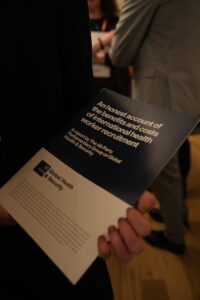
This reality is the starting point of a new cross-party parliamentary inquiry report - An honest account of the benefits and costs of international health worker recruitment.
And the report is just that – a clear-eyed examination of what it means for the UK to depend so heavily on health professionals trained elsewhere.
Launched at the UK Global Health Summit 2026, the report argues that the expertise sustaining the NHS did not arrive out of thin air.
These skills were built, developed and invested in by other health systems – many of which are already under strain. The NHS will continue to rely on this expertise for years to come.
If this is the case, the report argues, then the UK must respond in a much fairer and more responsible way: matching the benefits it gains with meaningful, long-term support for the health systems it recruits from.
It also makes another critical point: recognising that the reliance on international recruitment must go hand in hand with strengthening the UK’s own workforce planning.
Sustainable health services require the UK to train, retain and plan for the workforce it needs – so that international recruitment plays a deliberate, ethical role alongside domestic workforce planning, rather than acting as a short-term quick fix to shortages that better planning could prevent.
International health staff recruitment: the reality
The report found that the NHS is estimated to have saved around £14bn in training costs by employing doctors, nurses and GPs trained overseas.
It also details the broader benefits that the UK and other high-income countries gain from international recruitment, alongside the pressures it can place on countries already struggling to employ and retain enough health workers.
This is not an argument for international recruitment to stop.
For the stark reality is that if it did, the NHS would simply not cope.
Instead, the report argues for something different: fairness and humility.
If the UK benefits so significantly from the health systems of low and middle -income countries, then surely it carries a responsibility – not only to invest in those systems – but to also ensure its own workforce needs are not being met solely through global recruitment.
Better domestic planning – anticipating demand, expanding training places and improving retention of all staff, including internationally recruited and educated staff – must be part of the same conversation.
Partnership and global responsibility
For years, the discussions about international recruitment have swung between two poles.
On one hand, there has been celebration of overseas staff who contribute so much to the NHS.
On the other, anxiety about the UK’s ability to train and retain more of its own workforce and thereby reducing its dependence on overseas recruitment.
Both positions are true.
But neither fully acknowledge a fundamental reality: Britain’s ability to fill workforce gaps is deeply interconnected with the strengths and vulnerabilities of health systems elsewhere.
A sustainable NHS therefore requires both ethical global partnership and credible domestic health workforce planning.
The cross-party report urges the UK to adopt this wider view – to look beyond immediate staffing pressures and understand the global dynamics underpinning them.
It asks us to consider the real, on the ground consequences in Zimbabwe, Nigeria, Ghana and many other countries when richer nations draw skilled professionals from already stretched health systems.
What happens to maternity units, paediatric wards and primary health services in these countries when health workers – often some of the most experienced educators and practitioners – are continually pulled elsewhere?
It also asks us to reflect honestly on what ‘ethical recruitment’ truly means if low and middle -income countries bear the cost, while the UK, and other high-income countries, reap much of the benefit?
These are not abstract questions. They are urgent, practical and carry real world consequences.
Shaping Tomorrow’s Health, Together
The NHS will continue to rely on internationally trained staff for the foreseeable future.
But the path we choose now will define what fairness, partnership and responsibility look like in practice.
International recruitment will always be a valued and essential part of the UK’s health workforce.
But it cannot be the only pillar.
A sustainable future global health workforce requires an approach that does three things at once:
· Plans responsibly for the UK’s long-term staffing needs.
· Values and supports internationally recruited staff and the systems they come from.
· Builds global partnerships that strengthen health services on both sides.
This is not a choice between domestic training and international recruitment.
It is an invitation to do both better, and to recognise that the UK, as a major beneficiary of global health expertise, has both the opportunity and the responsibility to lead by example.
The report challenges us to take that step. And the time to do it is now.